2011-11-12

Must we become [worldview] Jews to become Christians?


The following is a letter I wrote to Bishop NT Wright about his constant emphasis on the 1st Century Jewish background of the New Testament. I am a big admirer of Wright, and I think he is largely right on in his "New Perspective" on Paul, as well as his strong emphasis on Resurrection as THE Christian Hope. I think his emphasis on the historical and cultural context of the New Testament is also right and necessary. Yet, sadly, it is also inaccessible for most people. If he responds to this email, I will post the reply.

2011-10-10

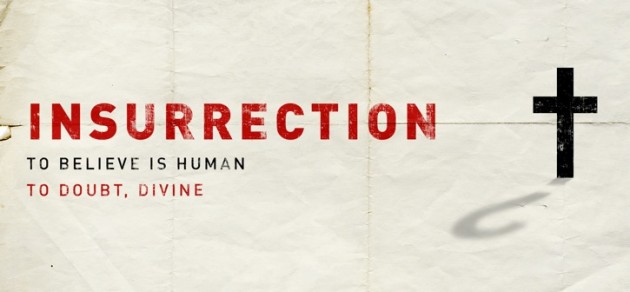
Friend or Frenemy? A Review of Peter Rollins' "Insurrection"


This is an off-the-top-of-my-head review of Peter Rollins newest book "Insurrection", which I read this weekend. The book was incredibly good, in that I deeply enjoyed reading it, and it gave me a great deal to ponder and wrestle with. At the end of the day, I value Rollins' ideas about how to existentially live out our faith in Christ on a daily basis. However, I have serious concerns over Rollins' re-visioning and re-definition of key elements of the Christian tradition. As such, Rollins is a sort of "frenemy" who, on one hand is a very helpful friend in elucidating certain aspects of what it means to follow Jesus in our culture. On the other hand, he is an enemy of certain historic Christian affirmations about God and Christ.

As a "frenemy" of Christ, Rollins maintains a place for God, at the cost of flattening God into just a Name for the structure of human psychological experience. As such, his thought is helpful as a bridge to Christ, in the same way that pantheism, panentheism, psychoanalysis and even Marxism can be bridges to Christ, all of which offer various points of commonality and intersection with Christ while also displaying broad areas of discordance. Here are some of the theological moves that Rollins makes in the book:

2011-09-15

Ockham Rap


This has to be one of the Geekiest things I have ever written. I am co-teaching a class called "The God Debate" about religious belief and unbelief. Several of the thinkers we have examined on both sides of the debate have referred to William of Ockham and his [in]famous "razor". For those who do not know, Ockham was a 14th century Franciscan Friar, a professor at the University of Oxford, one of the founders of the scientific method, and also excommunicated by the Pope for reasons that are partially philosophical and mostly political. 

A great summary of Ockham’s contributions to western thought is summed up by Roger Olson in “The Journey of Modern Theology”: Among other controversial ideas, Ockham expressed what came later to be known as Ockham’s razor—that simple principle that when one cause sufficiently explains a phenomenon, more should not be posited. At the time, and long before and afterwards, people tended to appeal to two causes for most events—a natural one and a supernatural one. For example, if a person became ill, it could be both because of an imbalance in the body’s humors and a demon. Also, celestial bodies such as planets were widely believed to be moved both by natural forces among them (such as some kind of magnetic field) and by angels. Ockham, much to the dismay of the church’s magisterium, suggested that the simplest explanation was always the wisest and only one. Many scholars see in Ockham and his razor the subtle beginning of a cultural earthquake whose shocks were to be felt much later in the scientific revolution.

Anyway, I thought, "Hey, I should write a rap song to explain Ockham." So, I did. What makes this even stranger is that I am more of a mystical Thomist with a serious affection for postmodern deconstruction. So, it is odd that after an hour and a half of doodling, this came out:

2011-09-12

The Moral Argument Against Religion


I am currently reading and teaching from the infamous books by Christopher Hitchens "God is not Great". In pondering Hitchens' arguments against God, I find myself continually underwhelmed (although very entertained). I do not find him persuasive, but rather rhetorically brilliant.

I think that the god Hitchens is arguing against is a god which I would argue against: A kind of "dictator in the sky" who cannot wait to damn the maximum number of people possible. The god he lambasts seems to be an evil elementary school principal writ large, and as such is the common concept of god among grade schoolers and teenagers. And since this is the age when a great many people stop going to Sunday School or challenging their ideas of god, it is also the god of a great many Americans.
This is a bunch of incoherent babble to make us think hard about our incredible love affair with the God of the universe, our astounding infidelities against God, and God's incredible grace to heal and restore us through Christ. Everything on this site is copyright © 1996-2023 by Nathan L. Bostian so if you use it, please cite me. You can contact me at natebostian [at] gmail [dot] com