Pursuing Theology, Ethics, and Spirituality that are Christlike: Christocentric, Healing, Reconciling, Incarnational, Sacramental, Trinitarian, Liberating, Inspired, Katholic, and Embracing. And other random stuff.
2026-05-24
Conserving the Progress of Pentecost
2025-09-25
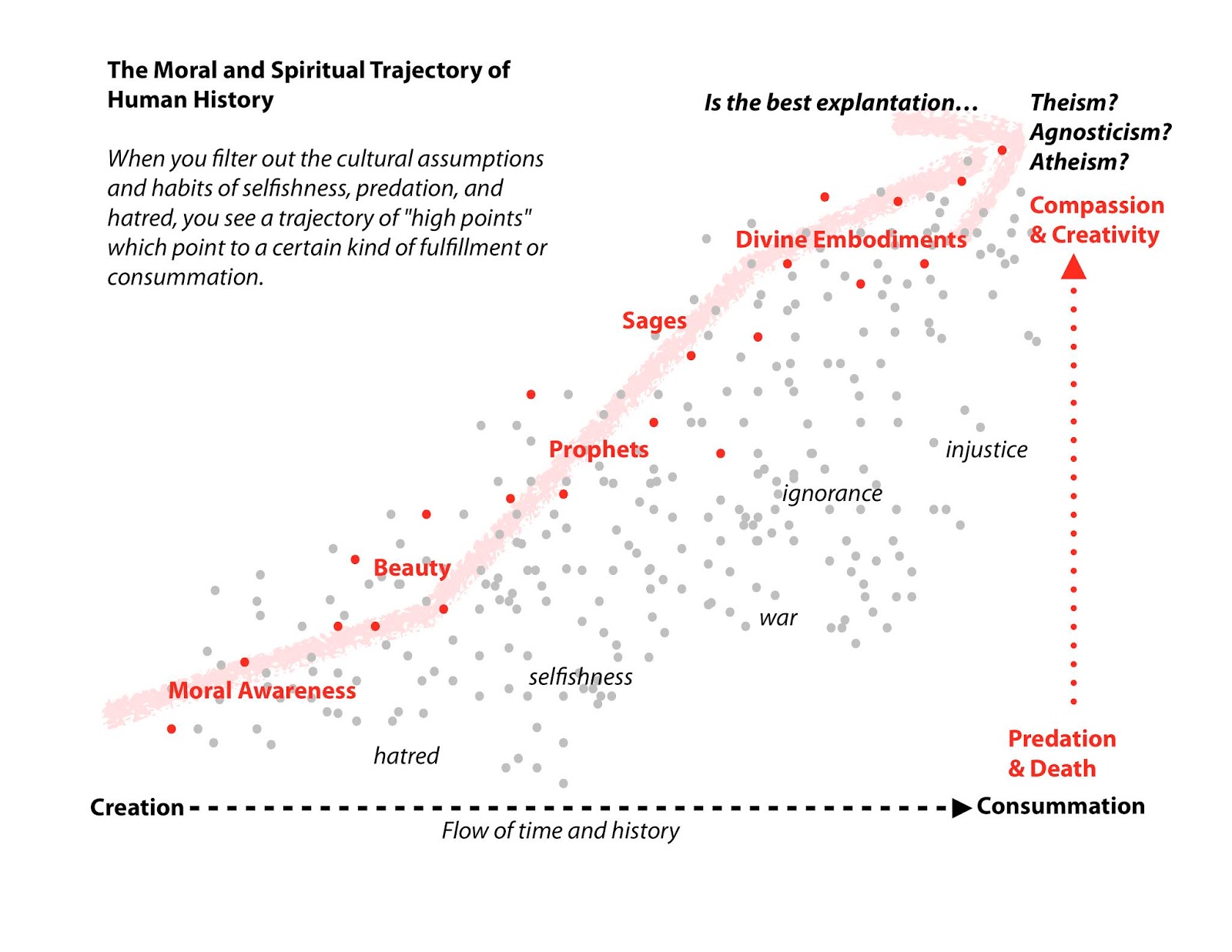
PROPHECY: Finding patterns in the events of history
This is a sample chapter from my Systematic Theology project "Theology for Thriving". 📎MORE TO THE STORY notes are not part of the main text of the book, but additional resources, charts, or other materials from Biblical Theology class resources.
1 Peter 1.6-13 [6] In this you rejoice, even if now for a little while you have had to suffer various trials, [7] so that the genuineness of your faith—being more precious than gold that, though perishable, is tested by fire—may be found to result in praise and glory and honor when Jesus Christ is revealed. [8] Although you have not seen him, you love him; and even though you do not see him now, you believe in him and rejoice with an indescribable and glorious joy, [9] for you are receiving the outcome of your faith, the salvation of your souls. [10] Concerning this salvation, the prophets who prophesied of the grace that was to be yours made careful search and inquiry, [11] inquiring about the person or time that the Spirit of Christ within them indicated when it testified in advance to the sufferings destined for Christ and the subsequent glory. [12] It was revealed to them that they were serving not themselves but you, in regard to the things that have now been announced to you through those who brought you good news by the Holy Spirit sent from heaven— things into which angels long to look! [13] Therefore prepare your minds for action; discipline yourselves; set all your hope on the grace that Jesus Christ will bring you when he is revealed.
2023-11-20
Constantine and the Complicated Canon of Scripture
2022-07-26
Should we rethink the dates of the New Testament?
2022-07-15
Twitter Gospel
2022-06-30
Weekly World Scripture Readings
From childhood you have known the sacred writings that are able to instruct you for salvation through the faithfulness which is in Christ Jesus. Every Scripture that is God-inspired is also useful for teaching, for correction, for restoration, and for training in justice, so that everyone who belongs to God may be proficient, equipped for every good work. [2Timothy 3.15-17]
This schedule of readings is designed to take the reader through the entire New Testament once per year, and the Old Testament (including the Hebrew Bible along with Christian Deuterocanonical literature) once every two years. This is a “weekly” reading plan instead of a “daily” reading plan, because with my schedule I often have no time to read for a day or two, and then a couple of hours for reading on another day. So, a weekly quota of reading works better for me. Also, I have arranged readings by theme or topic, instead of using Biblical order (which would put all of the Gospels in the first half of the year, while also disconnecting historical literature while reading through the Old Testament).
For instance, the New Testament readings start with John's Gospel and letters, which were chosen to begin the year because John intentionally echoes the creation narratives of Genesis. Then we read Luke’s Gospel and Acts, which tells the most well researched story of the early Jesus movement. Then we read most of Paul’s letters from earliest to latest, which give us an “inside account” of some of the stories in Acts. Then we read Mark and the letters of Peter, because of Mark’s traditional connection with Peter as the one who wrote his version of the Gospel. This is followed by Matthew’s Gospel and the writings and debates of the early Jewish Christian movement. We end with the writings of Paul commissioning the second generation of Church leaders, and then the final Victory of Christ over all evil in the book of Revelation.
For the Old Testament, odd-numbered years take us through the Torah, followed by Historical Literature, ordered from the oldest events depicted in the text, to the newest events (even though some books were written decades or centuries after the events they depict). In even-numbered years we read through the Psalms, Wisdom literature, and the Hebrew Prophets (ordered roughly from oldest written to newest). The New Testament readings average about 150 verses per week (usually 4-8 chapters) which is around 15-30 minutes read time. Old Testament readings average about 250-300 verses per week (usually 8-15 chapters) which is around 30-60 minutes read time.
In addition, after the Old Testament readings, there are optional readings from the major Scriptures of the world's largest and longest lasting Religions. Although some may find this odd to add to a Biblical reading plan, the study of the great Spiritual Paths of the world has deepened my walk with Jesus immeasurably. These texts help us gain basic fluency in the ways other cultures have pursued spiritual and ethical growth, and will help us understand the ideas and ideals of the Bible better by comparison and contrast with them. And in the words of the second century Church Father, Justin Martyr, we may even find “seeds of the Word” which Christ has planted in other Spiritual Paths to draw us to him.
Odd-numbered years will take us through foundational texts for Hinduism, Buddhism, and Confucianism. Even-numbered years will take us through the basic texts of Taoism, Islam, and Sikhism. These World Scripture readings are chosen to be 15-30 minutes in length. In total, for Biblical readings and World Scriptures, the weekly read time will be 1-2 hours, and may be divided up throughout the week, or read all at one time. I often will read Scripture three times per week: One day for the New Testament and Vital Verses. Another day for the Old Testament readings of the week. And a final day for World Scripture readings.
Finally, each week includes Scripture passages to meditate on and memorize which can be repeated aloud in about 30 seconds. Meditation here refers to focusing on Christ's presence in us by repeating a Divine Name, Prayer, or Scripture, over and over. These Scripture passages have been adapted to give us a focal point for meditation each week of the year. Using breathing prayer, we can use these as "arrow prayers" like the Jesus Prayer used in Orthodox Spirituality. Start by finding a meditative bodily position, whether seated or walking. Then repeat the Scriptural passage over and over as you breathe slowly. You may also use Prayer Beads or a Rosary to help you focus and keep track of your repetitions. The goal is to "treasure" these Truths, and store them deep within our self, so we become what we pray.
Regarding Scriptural Translations: I prefer Bible translations that include the entire Canon of Scripture, including the books which Jesus and Paul quoted, but Protestants have hidden away. Thus, I usually use the New Revised Standard Version [NRSV], the Common English Bible [CEB], or the New American Bible Revised Edition [NABRE]. For Hindu and Buddhist Scriptures, I am quite fond of Eknath Easwaran’s editions of the Upanishads, Bhagavad Gita, and Dhammapada. In addition, if you want a readable modern compendium of the main Vedic texts, read Wendy Doniger's "Rig Veda" from Penguin Classics. Although translations abound for Chinese Scriptures, for the Confucian Analects (Lun Yu), I have found the translations by Edward Slingerland and Nicholas Tamblyn to be helpful. For the Tao Te Ching (Daodejing), I find the Penguin Classics translation helpful, and the paraphrase of Stephen Mitchell inspiring. Given how short the Tao readings are, it may be helpful to read both versions side-by-side. For the Quran, I often switch between the Oxford World Classics edition and Itani’s Quran in Modern English. And finally, for the Sikh tradition a very helpful, modern, and concise abridgment of the massive Guru Granth Sahib can be found in “Hymns of the Sikh Gurus” by Nikky-Guninder Kaur Singh.
2021-11-10
Proverbs 31 and the Noble Spouse
2020-10-11
Noah's Flood and God's Justice
2020-05-11
Adventures in Book Binding 2020
For those who have known me for a while, you know I like binding books. In particular, you know I like re-binding Bibles in new and creative ways. Before my Bible and Prayer Book primarily took up residence on my smartphone and tablet, I even tried printing, compiling, and binding my own English-Hebrew-Greek study Bible. But, for most of my adulthood, that has taken the form of duct-tape binding. I have created duct-tape Bibles with flaps and velcro and extra storage space for pens and pencils. After having several duct tape Bibles for over a decade, I have found that over time they tend to degrade, get sticky on the outside, and have the velcro peel off. So, I started looking for a better solution...
2020-05-06
On Paul's "I have fought the good fight"
2020-03-02
Disarming the Canon
Recently a friend asked me: "Who decided that the Bible is as-is? Whose voices were included? Whose voices were omitted? Why these texts?" This is a great question, and gives me an excuse to write briefly about the process of "canonizing" the texts that would make up the Bible. This starts by defining terms. First of all, the Bible. The Bible comes from the Greek word "Biblia" meaning "Library of Texts". We think of the Bible as a single book, but in reality it is a library of at least 66 separate texts (but probably 80 or more!). These texts were written over a thousand years, from as early as 1000 BCE to as late as 100 CE, by dozens of different authors from wildly different walks of life, across different languages, different cultures, and different religious backgrounds.
So the question being asked is: Why did these books "make it in" to the Bible, while other texts did not?
2020-01-15
Three Ways to teach World Scriptures
In the modern era, there seems to be two major ways of teaching Scripture: As Oracle and as Literature. The Oracle view treats one set of Scriptures as an entirely Divine product which overrules any human contribution to the text. The Literature view is the opposite. Scriptural texts are entirely human products, and any Divine involvement (if there is such a thing) must be bracketed and excluded to truly understand them. Note that these labels are my way of quickly labeling two trends I have found in my experience as a student and teacher of Scripture and Religious Studies. I don’t know if anyone else uses these labels, but I do know that the phenomena which these labels describe occurs all the time in religious studies classrooms across the Western world.
2018-11-04
A provocation on Scriptural inspiration
2018-10-29
The Trajectory we follow in interpreting Scripture
What is of interest here is that, in the introduction to this reader (pages 2-3), I most clearly lay out how I interpret Scripture, and the main concerns I pay attention to when seeking to understand what God has revealed to us through Scripture. I have written elsewhere about how I apply the Biblical laws to our ethical life, and how Scriptural difficulties are worked out when we see Scripture as a process of Developmental Revelation, which is on a trajectory that is fulfilled in the person of Jesus Christ. In this understanding, to use words spoken by Martin Luther King Jr.: The Moral Arc of History (and Scripture) is long, but it trends toward Justice. This view has been shaped by voices as diverse as CS Lewis (in terms of overall narrative development of History), NT Wright (in terms of looking at the Old Testament from the perspective of the New Testament), Rabbi Jonathan Sacks (in his work on confronting violence in the Torah).
2018-05-21
Is the Letter to the Hebrews adoptionist?
A friend recently asked me if Hebrews 1.1-4 is "adoptionist". Adoptionism is an early Christian heresy which states that Jesus was not fully God and fully human during his entire Earthly life. Rather God "adopted" Jesus as the Son of God at his Baptism, when the Holy Spirit came upon Jesus and filled him with Divinity. Jesus was then "un-adopted" on the Cross, when he died and gave that Divine Spirit back to the Father. This idea raises serious questions for Incarnational and Trinitarian theology. For instance, God does not become fully and truly human from the womb to the tomb in the Adoptionist scheme.
Rather, God kind of "joy rides" Jesus of Nazareth for the "good" parts of his life, treating him like a Divine puppet, and then abandoning him at the time of greatest need on the cross. If this is the case, then not all of human life is redeemed and integrated into the life of God, just the "adult part" of life, until life gets hard as we near death. That is not full salvation for humans. And for God, it is not full empathy nor full solidarity with the human situation. For the Incarnation to be real and meaningful, it must include the entire human life, from the womb to the tomb and beyond. Thus, for these and many other reasons, the Church has rightfully rejected Adoptionism.
2018-04-27
How to read the Whole Bible
2022 Update: Based on the material found here, I have created an updated plan to read through the whole Bible. Click here to try this Weekly World Scripture Reader.
"I am really determined to read the entire bible cover to cover during my summer vacation. However, there seem to be so many choices of translation and I don't know which is better for my purposes. I want a Bible that is closest to the original translation but also full of helpful footnotes explaining things. Do you have any suggestions regarding a good bible? Also, feel free to recommend any companion books to go with it."
And so, this essay was born:
2017-07-25
On Noah’s Flood and the Nephilim
I often have friends and congregants who decide to read the Bible from front to back. But getting past the first few chapters is a formidable challenge, because the literature is so very different from what we expect from the Bible. We expect a Law Book or a History Book or objective reporting like a Newspaper. But what we get is something that is neither history nor fiction nor poetry nor prose. It is not until we reach the story of Abram and Sarai in chapter 12 that the story becomes predictably “human”. Until then it is a bit… weird.
If modern readers can get past the conflict between the two Creation narratives in chapters 1-2 (and their conflict with the narrative of evolution), and then make it past the talking snake in chapter 3, the next big shock to the system happens in chapter 6:
2015-01-09
So simplistic it's a sin
2013-11-18
Textual Evidence for Scriptural Reliability
| Click to see a chart comparing the NT to other ancient texts. |
These are my lecture notes on the question of how reliable the New Testament texts are, and a layman's introduction to textual criticism of the Bible.
It is often popular to claim that the NT text was corrupted by centuries of hand copying, and to point out the thousands of small differences between ancient copies as evidence of this. This is the claim often made by Mythicists (who claim that Jesus was wholly invented by early Christians) as well as more revisionist scholars (such as Bart Ehrman or "The Jesus Seminar"). But is this the case? It turns out, upon deeper inspection, that the Bible, especially the NT, is the most reliably copied book before the Printing Press (and the most printed after). Jewish and Christian Scriptoriums had meticulous standards to ensure copyist accuracy, and produced far more copies than any ancient book.
2013-10-22
Bible Memorization Rap
Click above to see a Rap Song I wrote to help students memorize the Bible, its major and minor divisions, and the major types of literature found in the Bible. Copyright (c) 2013 Nathan L. Bostian
Here are the lyrics: